
Watch the talk
David joined a fireside chat at the Haitian American Chamber of Commerce of Florida’s 2025 summit. The full conversation, lightly edited, is below in 13 parts, with the time each starts in the video.
- What private equity is and how it makes money 0:00
- The private equity playbook, for any owner 1:54
- Buy-and-build: why big businesses are worth more 5:04
- First impressions: what investors look at first 7:13
- Sellable vs. unsellable: existential risks 11:26
- What investors look for: profitability and quality of revenue 15:44
- Tariffs and uncertainty 19:59
- How businesses are valued 21:26
- Growth mistakes: conglomerates and growth without profit 30:54
- A client story: a family business that grew, then sold 36:29
- Why owners sell, and why selling isn’t binary 39:39
- What to do next 41:47
- Audience Q&A: buying a business, and starting vs. buying 45:00
What private equity is and how it makes money
At 0:00 in the video
Moderator: So give us a quick explanation. What exactly is private equity, and how does it differ from other types of investors?
David: Great. Private equity is an investment strategy that’s an alternative to public market investing. People could invest in stocks or bonds. They could buy a share of Microsoft. But there’s a whole group of investors that choose to buy private businesses, and the cash flow, and the improvements when they ultimately sell, are what drive the financial returns. Typically they’re funded by endowments from universities, pension funds that manage the retirement money of retirees, and ultra-high-net-worth individuals.
Private equity has a typical approach to how it invests. They buy into a business, but they have to exit their stake within a period of time that’s stipulated in their agreements with their investors, typically five to seven years. So they make their money in the exit. They’re experts at buying something, improving it in a variety of ways, growing it, and then ultimately selling it. That’s how they make the profits that provide the returns for their investors, and the private equity professionals earn a share of that profit, which is what induces them to do it.
The private equity playbook, for any owner
At 1:54 in the video
Moderator: So why is the private equity playbook so valuable for everyday business owners, even those who aren’t actively looking to sell? We talked a little about this yesterday: you’ve got to look for the opportunities even when you’re not necessarily ready to sell.
David: Well, in general with capital, the best time to look for it is when you don’t need it. When you’re in a crunch, nobody’s willing to give it to you.
I think the reason private equity is instructive is that these are people who professionally select the best talent in the world to execute a strategy to take private businesses and maximize their exit. They earn a percentage of that profit, so over the years they’ve systematically created a playbook that maximizes it, and they have a variety of tactics. One of the most traditional sources of value for private equity is using a lot of debt. Many people don’t like debt, and that’s okay. But what’s valuable is to say, “Let me look at the range of tools they use and cherry-pick which ones could apply to me, or which ones I feel comfortable using in my business,” because all of them are potentially valuable for growth.
I’ll name two typical tactics. The first is very basic and elementary, but very helpful. Before private equity even buys a business, before they write the check, they have what’s called an investment thesis. They already know, more or less, how big they want to get it in five years, who they want to sell it to, and what it’s going to look like, and they work backward. They say, “In five years, if I’m going to be at 500 million and we start at 100,” just to make the math simple, “then at the end of year one I need to be at 150, and at year two I need to be at 250.” Let’s say it’s a manufacturing business. What is it going to take to get there? I may need a certain number of salespeople to have that type of growth. I may need a larger facility. So everything is tied into a comprehensive strategic plan that they set at the beginning and try to execute.
Then, on a consistent basis, frequently weekly, they hold themselves accountable to it. They say, “Based on where we need to be at the end of the year, and we’re one month in, what do we need to accomplish to stay on track?” In a lot of ways, it’s less about the plan and more about the discipline of holding yourself accountable: this is where we expect to be, and if we’re not, how do we catch up, how do we hold the team accountable, and how do we incentivize them? Private equity also uses techniques like sharing equity, or other types of profit sharing or bonuses, to motivate other people, particularly key people on the team, to get to the next level.
Buy-and-build: why big businesses are worth more
At 5:04 in the video
David: There are a lot of other tactics, but so we don’t go down a rabbit hole, the second one that’s relevant is a phenomenon in the market: a big business is worth more, pound for pound, than a small business. Businesses are typically valued as a multiple of EBITDA, your profitability. So what do creative private equity professionals do when they see that phenomenon, which has been around for a long time? They say, “Let me put lots of small things together that I can buy relatively cheaply, and sell them as a big package for a higher amount.” Essentially, they make the spread between what they can buy the small things for and what they can sell the big thing for.
Moderator: I’ve actually been seeing that trend a lot in Florida in the landscaping industry. A lot of big funds are coming in and buying up a ton of smaller companies.
David: Yes. I think it’s important for people to be aware of private equity, because even if you say, “I don’t want to do any of that,” the reality is that private equity is shaping a lot of industries through consolidation. I know manufacturers whose distributors are getting bought up by private equity, and it’s changing the dynamics: you may have had 30 customers before, and all of a sudden you’ve got 12, or whatever it might be. It’s the leading edge of what typically happens across a lot of industries, which is consolidation. Consolidation often helps the profitability and value of a business, but for other companies in the ecosystem, it can be very disruptive. Pricing can go up, you can lose a customer, and so on. So it’s something to be aware of.
First impressions: what investors look at first
At 7:13 in the video
Moderator: One of the things David always says is that first impressions matter. From a buyer’s or investor’s point of view, what are some of the first things a private equity firm or an investor looks at in a business?
David: Great question. To me, first impressions are essential, because people make a split-second decision, and afterward it takes so much effort to overcome that inertia and change their initial viewpoint.
First and foremost, financials are something investors highly prioritize, because that’s the critical element they’re analyzing. Making sure your financials are clean, that everything reconciles, and that all the backup documentation is there is a key element. Even if your numbers are great, if they look disorganized, you’re starting off on the wrong foot in terms of the confidence somebody has in them from the beginning.
But in a lot of ways that’s secondary, because most of the time private equity is not going to see your financials up front. Typically, when you sell, an advisor will have relevant buyers sign a non-disclosure agreement, and once they sign it, they can see actual numbers. So their first impression tends to be your actual storefront or, more likely than not, your website. People make split-second decisions looking at a website: “This company feels like it’s from 20 years ago,” or “This is a cutting-edge business.” And it starts with a Google search. It’s not just your website. What’s coming up in your reviews? Is anything coming up about a lawsuit, an investigation, or anything else like that?
When you think about how to curate it, there are reputation management firms that can help with strategies to improve your ratings. A lot of businesses, when they have enough time in advance, hire a communications, marketing, advertising, or PR firm to get additional good publicity and tell their story in the best light possible. It may be purely with the intent of shaping what an investor sees when they Google the company, and the initial impression they get.
But it goes all the way through. Let’s say you have a manufacturing company. Eventually, before buying it, somebody will do a walk-through, and whether it’s neat and tidy sends a signal about the culture of the organization. It gives the buyer a sense of what it would feel like to own the business. You walk into a house that’s staged beautifully, and it has one feeling. In fact, I heard yesterday that people bake cookies to create that home feeling. It’s a very intentional experience, versus walking into a house a hoarder just lived in, with no preparation. Clearly you’re going to have a very different response, and ultimately a different value.
Moderator: It’s interesting you say that, because yesterday at our “Are You Lender Ready?” session, one of the first things the bankers and lenders said was, “We’ll give you money based on the story your numbers tell.” So it’s interesting to hear that other things matter when you’re looking to sell your business.
Sellable vs. unsellable: existential risks
At 11:26 in the video
Moderator: On that same note, in your experience, what separates a marketable business from one that’s unsellable?
David: That’s a great question. The statistic is that only about 50% of businesses are sellable, and for a lot of people that’s pretty shocking. Let me go to the root of what makes something unsellable. You have to put yourself in the buyer’s shoes. You think of a buyer as a big fund or a big company, but the reality is that individuals, employees, work for that company. And the easiest way for them to get fired is to tell their boss, “Yes, I want you to write a big check,” and then something happens and the next week everything is lost.
I like to describe these as existential risks: risks that, even though their likelihood is very low, would be so catastrophic that most buyers say, “At any price, it’s just not something I’m willing to do.” Unfortunately, when a business is unsellable, its best outcome is either to transition it to somebody else or to liquidate it: shut it down, collect all the money that’s owed, and stop operations.
What do I mean by existential risks? Things such as customer concentration. It may be highly unlikely that the big customer who represents half of your business leaves you, but the buyer doesn’t know that, and the buyer is thinking about the worst-case scenario. Another, which is much less technical and very common, is what we call key person risk. In some businesses, the individual is so important to sales and to everything else that, God forbid, if something were to happen to them, the whole business would unravel. That’s a lot easier to fix than, for example, customer concentration, but it’s easier said than done to build up the team. The hardest part, I find, is often for the business owner to let go and delegate.
There are other things. Litigation, for example. If your company is worth 10 million and you have a lawsuit that could be worth five, it’s so big relative to the company that it’s almost impossible to get around. Similarly, investigations and other governmental inquiries can be very damaging, because these private equity investors, since they’re funded by pension funds, are highly sensitive to […] not being in the news for the wrong reasons. Even if it’s the best investment, if they end up on the six o’clock news because something bad happened, no amount of profitability will generally induce them to do it.
Those are a few categories. The reality is that almost all of them can be addressed if you have the luxury of time. If you say, “I want to sell tomorrow,” that might be really difficult. But if you say, “I’ve got a couple of years,” you can work on it intentionally. Going back to the private equity planning I was talking about: “I have a lot of customer concentration. What am I going to do about it? By the end of this month, I’m going to have 10 meetings with other potential large clients. At the six-month mark, I need to have landed at least one or two.” And you hold yourself and your team accountable to getting there and improving whatever is detracting from your sellability. It’s not an exact science.
What investors look for: profitability and quality of revenue
At 15:44 in the video
Moderator: So you’re setting the trend for what kinds of companies a private equity firm looks for. What can these businesses do to set themselves apart and get ready to sell, and what advice would you give them?
David: First and foremost, what private equity and investors care about most is the financials. Strong profitability and growth are the most important. Having everything else without that isn’t really valuable.
But put that aside. Private equity is in the business of using debt as a large portion of its investment, just as, instead of buying a commercial building 100% with cash, you’d use a loan to buy a portion of it because you get a better return. Because of that, they are almost directly aligned with what banks prefer and find most financeable. So there are certain industries they tend to prefer because of their relative stability, but also because of what we call quality of revenue.
What I mean is that every dollar of sales is not created equal. Think about it as a spectrum. On one end, there’s revenue that’s a subscription you pay every month. In fact, you’re legally obligated through a contract to pay for the next few years. That is the holy grail of what an investor pays for, because ultimately they can rely on it. In the healthcare space, value-based models have a lot of those elements, because you know what payment you’re going to receive every month. The other extreme is project-based, discretionary work that somebody can defer. A construction company doing home remodeling, for example, is going to get a much lower valuation and less appetite, because, God forbid, there’s a recession, it’s much easier to lose that business. And in between those two points, there are plenty of things. Many businesses may not have contracts, but they have recurring customers who come in all the time. What’s really important is to show buyers and investors, ideally with data, that these are repeat customers you can expect to continue.
One last, really interesting example: car washes. Pretty basic business. There weren’t a lot of buyers for them 10 or 15 years ago. Then some creative entrepreneurs with private equity backgrounds changed them from pay-per-wash to a subscription model. You see all these tunnel washes […] charging you 50 dollars a month. Those are particularly attractive, and in the past few years they’ve sold for almost 20 times their profit, which is wildly expensive. That’s in particular because of the subscription model and very low labor costs. They outsource the vacuuming to you, and they essentially have one or two people on site to open up and refill the chemicals.
Tariffs and uncertainty
At 19:59 in the video
David: The last thing I wanted to mention is that we’re living through a very uncertain time, with changes occurring governmentally, with tariffs, and all of that. So I would expect to see some shifts over the coming years in what buyers focus on, relative to before. In the past few weeks, I’ve personally been seeing businesses that may have done very well but had, for example, 80% of their materials coming from China, and it’s unclear what’s going to happen with the tariffs. No investor wants to pay top dollar for something when they have no clue whether it’s going to make money or have a real problem and have to shut down soon.
Moderator: It’s interesting you said that, because when I was speaking with one of the lenders yesterday, he said that right now they’re looking for manufacturing companies, in-house manufacturing. So I see that the trend is changing a little.
How businesses are valued
At 21:26 in the video
Moderator: You talked about valuation. How are companies valued? What is the process, and how do you know if you’re valuable?
David: From a valuation standpoint, the first point I want to make is that it’s incredibly subjective. Unlike selling a house, where everything about what it sold for is public, the actual data on what businesses sold for in the past is very sparse. You’re talking about maybe 100 to 200 data points available publicly in the entire United States each year. [Editor’s note: the count of publicly disclosed small-business deals varies by source; the point is that reliable private-company data is scarce.] I think it’s important for people to understand that, because it’s not some black magic that your company is worth X. The only way to know exactly what your business is worth is to put it on the market and sell it.
But there is a way to estimate it, by triangulating. Essentially, you value the business by analogy: “Here’s another business that sold recently, in the same industry and around the same size, and it sold for this, but it has slightly different characteristics. And here’s another business with exactly the same characteristics, but it sold five years ago.” That gives you directional guidance on what your business is worth. On average, if you look at the middle market, businesses sell for around six times earnings. In other words, if you make a million dollars of profit, you would sell the business for about six million dollars in total. [Editor’s note: multiples vary widely by size, sector, and quality; see Get Your Range for a range specific to your business.]
Now, there are three drivers of whether a multiple is higher or lower. I can explain the math, but the essence is pretty basic. The first is growth. All other things equal, if a business is growing, a buyer can pay more for it. If you were buying a property to rent out and the rent next year was going to go up a lot, you’d be willing and able to pay more than if there were no growth or, on the contrary, it was shrinking. And when a business is shrinking, the owner often faces a heavy penalty on valuation in the market.
The second is risk. At the end of the day, people will only pay up for something with a low level of uncertainty. In other words, certainty drives higher valuations. Risk comes in a lot of ways. It can come from industries with a lot of cyclicality. […] In some industries, for better or for worse, you typically have six years where things go up and then two years where things go down. That’s just the way the cycles work. Other businesses are almost immune. The more uncertainty you can eliminate, the higher the valuation.
Moderator: You said some of those businesses are immune. You’ve got to tell me what those are, because that’s where I need to invest.
David: Look, with AI and everything, anybody who says a business is riskless has never really been a true business person. I always say that in college I did all these business plan competitions and thought I was an entrepreneur. But it wasn’t until I lost my job and started my company 15 years ago, and my bank account started going down every month, that I started understanding what it feels like to be an entrepreneur. Everybody who has gone through it has been there.
But there are certain industries that are more essential. Essential services, for example. There’s a tremendous amount of private equity appetite right now in things like home services. In air conditioning repair, there are some large consolidators paying often 8 to 10 times annual profit, and well above that for large companies, because their thesis is that, looking at the region, nobody is going to go without air conditioning, the population is growing, and there’s a limited universe of people who know how to fix it themselves. So pretty much, if the price goes up, you’re going to pay it. There are a lot of other businesses like that. Healthcare has some aspects of it. But it’s important to distinguish between whether the industry is going to continue and whether you can continue to make high profits. Those are two different things. It’s guaranteed that in healthcare you’re going to have primary care, because society needs it. The question, particularly with Medicare setting its rates, is whether the profitability is going to be high. It’s the intersection of staying power and the ability to keep earning profit sustainably.
And the third is a hodgepodge of factors I call supply and demand. If we remember from economics class, the more demand there is, the higher the price, and conversely, with a lot of supply, prices fall. So if there are a lot of the same type of business on the market at the same time, pricing is generally going to be lower, because the buyers can say, “If I don’t buy this business, I’ll find another one.”
The last thing I want to mention ties to the private equity investment strategy. I like to look at the world as businesses that are at scale and businesses that are below scale. Going back to the idea that private equity consolidates, what they’re often doing is finding what’s called a platform business: an initial business that’s big enough, with the infrastructure, financial means, and wherewithal, to go out and buy smaller businesses and absorb them consistently. Nine mothers don’t make a baby any faster, so you can’t just get a small, informal business to do that. You need one that has the technology, the systems, and everything in place. In general, depending on the industry, a business needs about 3 to 5 million dollars of annual profit. Once it reaches that level, you open yourself up to the entire universe of private equity firms. There are about 2,000 in the United States, and currently they have about a trillion dollars of dry powder, meaning money they have not yet invested. If they don’t invest it, they lose it, so they have a huge incentive to put it to work. That entire universe could be a buyer.
But if you’re subscale, meaning you’re at one or two million dollars, then, as before private equity existed (and private equity in that size range is relatively new, from the past 30 years), the only person you could sell to is another local person who gets an SBA loan and buys the business. When you’re selling that business, the only buyers are people who have an existing business in your region and industry, and the financial means to do it. So you go from, let’s say, 300 potential buyers to, if you’re a small air conditioning repair business, maybe three. That’s why the larger business has a much higher valuation: it has a much larger universe of potential buyers, versus a small number who say, “If you don’t make it worth my while, I’ll look at something else or invest in my own business.”
Growth mistakes: conglomerates and growth without profit
At 30:54 in the video
Moderator: What are some of the most common mistakes business owners make when they’re trying to grow or sell their business?
David: I’ll start with growth. Look, I don’t think there’s a right or wrong around deciding whether to sell. That’s a very personal decision. But if you ultimately do want to sell, there are certain types of growth that are not as valuable.
Moderator: Wait, growth not valuable? Tell me more.
David: Going back to what I just talked about, private equity likes to consolidate things that are very similar. So what’s not a good fit for growth is trying to build a conglomerate. It might be good for you and your lifestyle. You may enjoy it, and there might be opportunities. But I often find, particularly with clients who come from Latin America, that they may own a bank, a grocery chain, and something else. The problem is that there’s no single buyer for all of it. Going back to what I described before, big things trade at a higher multiple than small things, and what happens when they try to sell is the reverse of that phenomenon: they have to sell in pieces, and each piece individually is going to sell for a really low multiple.
So when you do grow, particularly if the goal is to ultimately sell, I think there should be a premium on acquiring things that strategically make sense together. If you have a dental chain, don’t add something totally different. You can go into orthodontics or some of the specialties. Because if you have all those other things, one of two things happens, and neither is good. The buyer will either say, “You’ve got all these other assets you value, but I don’t want them, and I’m not going to pay you anything for them.” Or you’ll have a limited universe of buyers, where maybe one or two would say, “Yes, I’ll buy the whole thing,” but you’ve eliminated all the other potential buyers. At the end of the day, when there are only one or two people who can buy your business, it’s very difficult to get the full value you deserve for your life’s work. People with a lot of entrepreneurial talent and drive come across these different opportunities and start collecting, so just being aware of that is important.
The second, on the growth front, is that growth without profitability generally isn’t going to get you much. Ultimately, it’s a lot more stress and headache. Pretty much every investor values a business on what it will provide them as an owner going forward, so it has less to do with the top line and more to do with how much you ultimately get to keep. There’s a limit to that, in that you can only cut costs so much. So the ideal scenario is that you maintain a consistent level of profitability and you grow.
For businesses in that situation, two things are helpful. One is to look inside your business, at your information, and ask: Where am I currently making money? Where am I currently growing? What are my people on the ground telling me about where there’s opportunity I should invest my time, energy, and money in? A lot of times, people don’t subdivide it and look at it that granularly. But every business typically has certain areas doing really well, and others where you may not have even realized you’re losing money. So really analyzing your own business and deriving those insights from the inside is valuable.
The second is to look from the outside: what’s currently happening in the market, where private equity is investing, and what they’re prioritizing. For example, going back to air conditioning, higher premiums are paid for residential air conditioning repair companies than for those doing commercial and industrial work. So if you’re a business owner and you know that, you might say, “I’ve got both, and I’m not going to cut one off, but I’m going to put my energy into building up the residential side.” That type of research and effort is helpful. And then you keep monitoring and iterating, because you have a business plan and you hope it goes according to plan, but your initial thesis about what could or should work may not pan out. It’s continuously refining and improving, and ultimately that’s how you get there.
A client story: a family business that grew, then sold
At 36:29 in the video
Moderator: You’ve helped negotiate billions of dollars in deals. Can you share some real-world stories where owners followed these principles to achieve a strong exit?
David: It was actually one of my earlier transactions. I started out helping them more on the strategy side, and in a lot of ways I helped them implement the private equity playbook. They produced a product that was sold in most home improvement stores across the country, and they had a number of growth plans: to expand to new geographic locations, but also to expand their product mix. Over a two-year period, and quite frankly without any intention to sell, they went through this exercise of trying to improve the value of their business. It was a family business, with some family members in it and some who were not, and their objective was to make it as strong a business as possible.
Through that process, they developed the discipline of collecting the data to make good, informed decisions, and the discipline of holding themselves accountable to weekly, monthly, and quarterly goals. Long story short, over those two years they grew nicely, probably 50% plus. Then different factors emerged. Somebody proposed that they take a minority investment, and that made them decide, “If we’re going to accept that, maybe we should look at what it would look like to sell the whole thing, what it would be worth, and make sure it’s fair.” Ultimately, in those conversations, the decision was made to sell the business, and they had a great financial exit.
Interestingly, and this came up in our conversation before the panel, they sold 80% of it, and the operator, who was married into the family, said afterward that it improved his quality of life significantly, because it took out some of the family dynamics. Everybody has an opinion, and a lot of times the people who are not working in the business have very strong opinions about how things should go. Eliminating that, and having it run like a traditional company, gave him a much better quality of life and minimized a lot of the friction within the family.
Why owners sell, and why selling isn’t binary
At 39:39 in the video
Moderator: For a little clarity, David and I were talking earlier about family businesses, because traditionally in a lot of Haitian and immigrant households, we tend to start a business so that the rest of the family can take it over, or we have them join us. […]
David: People talk about selling purely from the financial standpoint, but a lot of people are motivated to sell for other reasons. Obviously you want to receive the money, but sometimes it’s because “I want a quieter lifestyle. I want less stress. I want to be able to take a vacation with my family.” Other people want the exact opposite. They want to grow more aggressively, but they don’t want to fund it with their own money. Other people want a solution that lets them distribute money among family members without creating perceptions that one person got a better deal than another. So there are a lot of reasons people turn to selling.
I think it’s also really important to mention that, in some ways, my book is mistitled. “Selling” implies a binary thing: you either sell or you don’t. But the reality is there are a lot of permutations in between. You could sell a portion. You could do what’s called a debt recap, where you take a large special distribution from the company, funded by a loan that’s non-recourse against the business. [Editor’s note: in a dividend recapitalization, the company borrows against its own cash flow and the loan is typically non-recourse to the owner personally.] So there are a lot of different options. Ultimately, the common thread in why most people do a transaction is that they want to secure their family’s future, diversify, and compartmentalize it outside the business. Because, as we mentioned earlier, while you try to do everything you can to de-risk the business, there’s no guarantee. A lot of times the motivation is, “God forbid something happens, at least my family is taken care of financially.”
What to do next
At 41:47 in the video
Moderator: This is going to be the last question, and then I think we’ll have time for one question from the audience. Thank you so much for everything you’ve shared. For everyone here: what’s the one thing to do after you leave today? I’m a business owner, I’m thinking about selling, I’m mid-market, I’m ready. What’s my next step?
David: I think the most important thing is to educate yourself and start preparing, because interestingly, we find that only about one out of four business owners who come to us have done any preparation. The reason is that the urgent pushes out the important. I get it. It’s hard enough, and every spare moment you have, you want to spend with your family. It’s difficult to work on the strategic things in your business.
What I mean by educating yourself is that when you sell, you’re going up against professional, repeat buyers, so it’s really important to surround yourself with professionals who do this consistently. Basically, call [us]. And even if it’s not us, find somebody you trust who fits with you to represent you, because there are a ton of studies that show you’re going to make more money and close with a higher likelihood. [Editor’s note: published studies estimate the price premium from hiring an advisor at roughly 6% to 25%, depending on method; see our guide to M&A advisor fees.] Probably the most important thing: these private equity firms are not in the business of charity, and they use an advisor to sell 100% of the time.
The advantage is that pretty much every advisor I’m aware of will have a conversation for free. So at worst, you’ll glean a lot of information from these individuals about what they’re seeing out there, what they think is driving the industry, and industry insights that can help you run your business better. It helps even if you don’t intend to sell today, but in five years, or you don’t really have a plan. What’s the true cost of that one-hour conversation?
Then come up with a system that works for you, so you can actually implement some of the things that improve the value of the business. Typically, you’ll brainstorm with your team and your family 60 different items you could improve. But then you need to prioritize them, because you can’t do 60 at the same time. If you try to do 60, you won’t do any of them. So you say, “This month I’m going to work on this one, and over the next six months I’m going to work on these three.” Even if they’re all valuable, getting the insight from somebody who can say, “Depending on when you want to sell, I would choose these three first,” can really give you guidance and help you start.
Audience Q&A: buying a business, and starting vs. buying
At 45:00 in the video
Audience member: Good afternoon, and thank you for the information. I see online that a lot of baby boomers are selling their businesses. Where do you go to find those businesses, and how do you find them and negotiate?
David: It’s a great question, and I have a little experience with this, because I’ve done it a couple of times and found businesses I was able to buy. Demographically, it’s a fact that baby boomers are getting older, and the average age of business owners is getting older. There’s actually an expectation that by 2030, 50% of businesses will sell, so call it roughly 10% a year. Unfortunately, there’s a concern among owners that if people know you’re selling, it will be used against you, that your customers might leave or your employees might get scared. So it’s not as easy as finding a database and buying a business like buying a stock.
There are essentially two paths. Path one is to go to business brokers, typically for smaller businesses, who have listings. I believe the Florida business brokers association has a consolidated group of listings of lots of different businesses represented by brokers. The second approach, which typically lets you buy best, is to develop relationships with business owners yourself. That means going out in the community and leveraging the relationships you have, whether through your industry, your geography, or the chamber, to identify business owners you can start a conversation with. When you start the conversation, you don’t know their numbers or anything else, but the conversation is, “Look, this is something I’d like to do. Let’s sit down so I can understand more about your business, and if there’s a fit, I’ll sign a non-disclosure agreement, you’ll share more information, and then we can negotiate.”
The one thing I will say is that it’s a long and challenging process. On average, people who take that approach to buying a business take about two years. My experience was a little over two years to buy my first business, in 2016. So it is possible, but it’s a very inefficient world that requires a lot of heavy lifting, conversations, and meetings to connect the dots. If you think about private equity, for every investment they make, they look at a hundred, most of the time. It takes patience and discipline to make sure you’re buying something high quality at a good price.
Moderator: Is it weird that I have a question now? A really quick one, rapid fire. Most people here have started their own businesses, but what would you recommend: start your own business or buy one? Sometimes you don’t want to go through the whole process of starting from scratch.
David: That’s a great question. There are pros and cons to each. The value of buying a business is that you start with something that already works, and you can borrow against it. With an SBA loan for an existing business (I know the rules changed in the past couple of days, but my understanding is) people can often borrow up to 90%. [Editor’s note: SBA lending terms as of the talk, mid-2025; check current rules.] That’s a huge advantage of buying an existing business versus starting something from scratch, where the bank can’t lend against it because there’s no history.
That said, I think it’s really important to be sensitive to the culture, particularly in a small business. Even a big business is only its people. It needs people to make decisions, to run the machines, to distribute and sell. So it’s really important to have the operational skill set to manage people. Full disclosure, I’ve realized that’s not my greatest strength. Some people are good at it, and it’s important to know yourself, because I’ve known people who bought a small business and the day after closing, everybody quit. So there are risks inherent in it too. There’s no right or wrong answer, but particularly if you understand the industry and you’re an operator from it, it’s often faster and much more profitable to start by buying one.
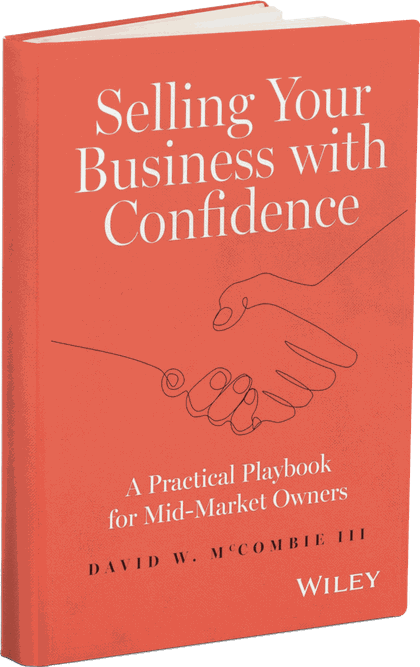
Moderator: Thank you so much, David. I’d definitely recommend checking out David’s book, Selling Your Business with Confidence.
Keep reading
This transcript was lightly edited for readability: filler words removed and paragraphs added; the meaning is unchanged. Bracketed notes were added for this page, and […] marks a short passage left out. General education, not legal, tax, or investment advice.