Home  /  What We Do  /  Sell

Sell on your terms, from a position of strength.

You’ll likely sell your business once. The buyers across the table do this for a living. We represent you, and only you, from the first conversation to closing: a confidential, competitive process built to maximize price, fit, and certainty of close.

It starts with what you want: your timing, your desired role after closing, and what happens to your team. Then we design the process around it.

Get Your Range

Free and confidential: about two minutes of questions, then a preliminary value range by email.

Start a Confidential Conversation

Most owners who talk to us aren’t selling yet.

Talking to us doesn’t start a sale.

How McCombie Group helps owners sell · 3:42 · Read the transcript

~$2B
in closed M&A transactions.
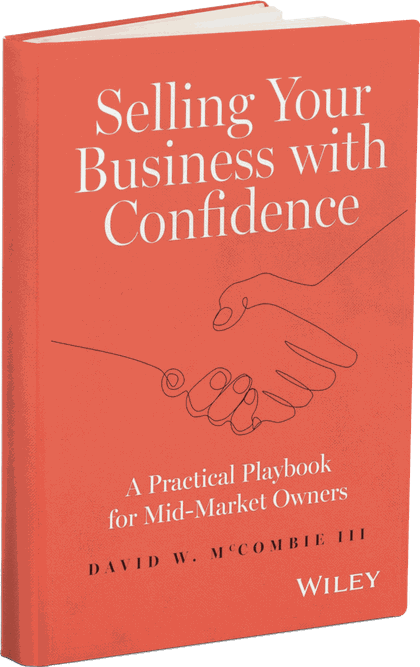
Selling Your Business with Confidence-- by David W. McCombie III, published by Wiley
AmazonBest-seller
25th Annual M&A Advisor Awards, 2026: Boutique Investment Banking Firm of the Year finalist USA M&A Atlas Awards 2023: Growth Investment Deal of the Year winner USA M&A Atlas Awards 2023: Boutique Investment Bank finalist
What a good outcome means

Price is one of three things you’re negotiating.

Most owners judge a sale by the headline number. But most mid-market deals aren’t paid entirely in cash at closing. Part of the price usually comes later, through a payment tied to future results (an earn-out), a seller note, or equity you roll over alongside the buyer, so a sale typically starts a financial partnership that lasts at least a couple of years, and sometimes ten or more. The outcome you live with depends on the price, who you’re partnering with, and whether the deal you sign is the deal that closes. We negotiate all three, weighted the way you weight them.

Price

Real competition among the right buyers is what moves price. A buyer negotiating alone sets its own. We compare each offer on a cash-equivalent basis, not on the headline.

Fit

We help you choose the ideal partner for your team, your legacy, and your next chapter, then push that buyer’s price as far as it will go.

Certainty

A price in the buyer’s final written offer (letter of intent) is a ceiling, not a promise. Preparation that holds up in the buyer’s detailed check (diligence), and buyers vetted for commitment and ability to pay, are what get deals to close successfully.

Our role

Your advocate from the first conversation to closing.

We give owners unbiased, straightforward advice and representation. It starts with listening: what you want personally and professionally, and what really drives your business. Then we carry the workload of the sale so you can keep running the company. That matters more than most owners expect, because financial and operational results that slip during a sale tend to show up in the price.

Before any buyer sees your name
  • Set the strategy around your goals: timing, your role after closing, your team
  • Prepare buyer-ready financials: we recast them in-house the way a buyer’s accountants will, adjusting for owner perks, one-time costs, and personal expenses, so the numbers show what the company truly earns. Then we fix what they’d flag, before anyone sees it. Think of it as a pre-listing inspection for your financials.
  • Establish a realistic valuation range and the market terms to expect
  • Shape the story buyers will hear, and write the materials that tell it: the teaser, the confidential information memorandum, and the financial model
  • Build the buyer list with you, screened for fit and ability to pay
  • Organize the data room before anyone asks
Once you’re in the market
  • Run confidential outreach to the relevant buyer universe
  • Handle every buyer contact, question, and request
  • Prepare you and your team for management meetings
  • Set the deadlines that keep buyers competing, and hold everyone to them
  • Compare offers on a consistent, cash-equivalent basis, then give you our recommendation
  • Negotiate price and terms, with every term discussion running through us
  • Manage diligence and the closing timeline, alongside your attorney and accountant

We’re also candid about when not to sell. If the market, the numbers, or your goals point to waiting, raising capital, or building value first, we’ll tell you. Getting ready to sell →

The process

Eight to nine months, run to a plan.

A well-prepared sale typically takes 8 to 9 months from preparation to close-- plan for up to 12, to account for unexpected delays. Every process is tailored: wider when your company is rare and coveted, more targeted when fit and confidentiality matter most. Either way, buyers bid in two rounds against firm deadlines, so the price that wins has been tested.

M1M2M3M4M5M6M7M8M9
PreparationValuation range · financial cleanup · CIM · buyer list
Confidential marketingCurated outreach under NDA
Offers & negotiationFirst bids (IOIs) · management meetings · final offers (LOIs)
Diligence & closeConfirmatory diligence · legal · closing

Post-close: most premium outcomes require an owner transition of one to three years.

Months 1–3

Preparation

Your goals set the strategy. We prepare buyer-ready financials, including adjusted annual profit (EBITDA) and a data book, set the valuation range and positioning, write the teaser and confidential information memorandum, build the buyer list with you, and organize the data room.

Months 4–5

Confidential marketing

Personal outreach to each buyer on the list. Each signs a confidentiality agreement before learning your name, then studies the memorandum and asks questions. We handle every conversation, so you don’t hear from a buyer until it has submitted a preliminary offer that shows it’s in the right ballpark.

Months 5–6

Offers and negotiation

The strongest few meet you and your team. Letters of intent arrive by a set deadline, are compared on price, structure, terms, and fit, and are negotiated before you grant exclusivity, while you still have the leverage.

Months 7–9

Diligence and close

Confirmatory diligence and the purchase agreement, run to a timetable both sides agree on, with regular check-ins that hold the buyer to it. Your attorney and accountant lead the legal and tax work; we keep the deal on track through closing.

After closing, we’re capable of supporting you all the way through the working capital true-up and any earn-outs.

The buyers

The right buyers competing, not the first caller negotiating alone with you.

We build a customized buyer list for every engagement, around your goals and your business, rather than reusing the last deal’s list. It usually spans three kinds of buyers. Each values different things and offers different terms, so each gets different questions.

Strategic acquirers

Companies in or near your industry, sometimes a supplier or a customer. They may be public, privately held, or backed by investment firms that buy companies (private equity); either way, they often pay for synergies and market position.

Ask: what happens to your team, your role, and your location after integration?

Private equity platforms

Firms buying control of a strong company to build on, often with you rolling over part of your equity alongside them.

Ask: what’s their plan, their timeline to the next sale, and the role they expect you to play?

Family offices and independent sponsors

Private capital that can bring longer horizons or more flexible structures.

Ask: where is the money coming from, and how certain is it?

Buyers negotiate for a living. Expect these moves.

Asking for exclusivity early

A preemptive offer with a short fuse is designed to end the competition. We keep serious buyers inside the process, where they bid against real alternatives.

Going around your advisor

Some buyers will call you directly to see whether they get a different answer. Talk operations and integration freely; keep price and terms with us, so no one negotiates around you.

Testing your floor

Numbers floated in casual conversation are probes for the least amount you’re willing to accept. You never have to answer them. Offers come in writing, by the deadline, on the same basis as everyone else’s.

Bidding high, then retrading

A big number can win exclusivity, followed by price cuts over minor diligence findings. A detailed letter of intent, and numbers we’ve already pressure-tested and stand behind going in, help keep that risk to a minimum.

Slowing down diligence

Once exclusivity starts, time works for the buyer. We mutually agree on a timetable up front and hold both sides to it.

Promising more than they’ll deliver

Commitments to your team or your role are easy to make before closing. We help you vet how a buyer has treated similar owners it bought from, before you sign a letter of intent.

None of it is personal. It’s how professional buyers negotiate, and we’ve sat on their side of the table too.

Offers and the letter of intent

The headline price is not the money.

Two letters of intent with the same price can be worth very different amounts to you. What matters is how much arrives in cash at closing, how much depends on events after it, and how likely the deal is to close at all.

Offer A$40M headline

$34M cash at closing · $2M escrow · $4M earn-out

Offer B$40M headline

$24M cash at closing · $4M seller note · $4M escrow · $8M earn-out

Same headline. Offer B leaves $16 million riding on future results, a buyer’s ability to pay, and a claims process. We put every offer on the same cash-equivalent basis, weigh how likely each buyer is to close, and tell you what we’d choose and why. The ultimate decision is yours.

Illustration only: hypothetical offers. Real structures depend on the business, the buyer, and the market.

Your leverage peaks before you sign.

A letter of intent is usually the best price and terms you’ll see. Buyers rarely improve an offer once they have exclusivity, and anything left vague tends to be read against the seller later. So we settle what matters while buyers are still competing: how earnings are defined, how any earn-out works, the working capital left in the business, the terms of your non-compete, and whether the buyer’s investment committee and financing are lined up.

Before you sign
  • Several buyers competing for the deal
  • You set the deadlines
  • Every term is still open, and every improvement is won against an alternative
After you grant exclusivity
  • One buyer, with no alternative on the table
  • Time starts working for the buyer
  • Diligence findings become reasons to revisit the price, rarely to raise it

Want to see what a buyer might pay for your business, and how much of it could arrive at closing?

Get Your Range

Free and confidential: about two minutes of questions, then a preliminary value range by email.

Start a Confidential Conversation

Most owners who talk to us aren’t selling yet.

The human side

It’s your life’s work. We treat it that way.

Your business isn’t just a number. It’s your legacy, and selling it is a life-changing financial event and a deeply personal one. Your team, your customers, your name in the community, and your own next chapter all ride on who buys and how.

So we pair execution with coaching: weighing the high-stakes decisions with you, planning what to tell your key leaders, employees, customers, and family, and when, and keeping perspective when the process gets tense. Success means an outcome you’re still satisfied with years later, not just at closing.

Most owners stay on for a transition after closing, often a year or more, and longer when the business depends heavily on them. We help you shape that role before you sign, while buyers are still competing, not after.

Our standard is simple: we advise as if it were our own family’s business.

When to move

“Should I sell my business now, or wait?”

“Should I sell now, or wait?” is the first question nearly every owner asks-- and nobody has a crystal ball. But two decades of transaction experience points one way: owners wait too long far more often than they sell too early. They hold out for the last dollar, assume today’s conditions last, and find the risk was asymmetric-- more room to miss on the downside than to be surprised on the upside.

The goal isn’t to time it perfectly. It’s to tilt the odds in your favor. Timing is the one lever fully in your control. And one honest rule: if you’re not emotionally ready, the timing is wrong whatever the market says, because a failed process is costly.

Four categories of factors should drive the call-- the questions only you can answer about your own situation. Our best-prepared clients review them every year, well before deciding to transact.

I.

Company trajectory

  • Will next year realistically be better or worse than today?
  • Are margins increasing or decreasing? Are you gaining or losing share in your market?
  • Is your business of sufficient scale to be the first company a buyer acquires in your industry (a platform)-- or one it buys next (an add-on)?
  • Do you have a viable second-in-command, or does every decision run through you?
  • How much work and investment would a peak transaction require-- and is the risk/return of doing it first worth it?
II.

Your position in the industry

  • How long has private equity been investing in your industry, and is consolidation early or late?
  • How fast is your industry growing, and which trends are working for or against you?
  • Are competitors, suppliers, or customers consolidating, and what does that do to your risk?
  • Are there regulatory changes on the horizon?
III.

Market environment

  • What’s the lending environment? When credit is cheap and loose, buyers stretch; when the window shuts, it shuts abruptly.
  • Is your revenue pro-cyclical or defensive-- and what does that mean for when you should move?
  • Are deal multiples in your industry above or below their historical averages?
  • How would a recession in the next two years change your numbers-- and your negotiating position?
IV.

Personal factors

  • Do you still feel passion for the business, or are you running on fatigue?
  • At what age do you want to be fully transitioned? Work backward four to six years: transition period, process time, and buffer to credibly walk away.
  • Will a transaction produce sufficient after-tax proceeds for your family’s goals?
  • Are you psychologically ready to have a partner (or a boss) even temporarily?
The short answer

The best time to transact is when your revenue and margins have grown consistently for two or more years, the consolidation cycle still has premium runway, and you are personally ready, financially and emotionally, for what comes after. A well-run confidential process typically takes eight to nine months. Owners who plan four to six years ahead of their target date consistently achieve better prices and terms than owners reacting to an unsolicited offer or a life event.

Work backward from your exit date in the When to Sell: Timing Check →

Need the preparation years? Getting ready to sell →

Designing your ideal life

Do you want to slow down-- or scale up?

Nearly every owner who calls us wants the same first thing: money out of the business to protect their family’s future. Turning wealth that’s tied up in one company into diversified wealth that’s walled off from the business is close to universal. Past that, motivations split-- often in diametrically opposed directions, depending on family situation, energy, and what the ideal next chapter looks like.

The question that sorts almost everything else: after the transaction, do you want to work less, or are you prepared to work as hard as ever (maybe harder) for some major upside?

Path one

Slow down

Retire, or step back to fewer hours and a defined role. You want a buyer with its own leadership bench and a respectful transition measured over one to two years (up to three for premium outcomes).

Points toward: a full sale, with fit and certainty of close weighted alongside price.
Path two

Scale up

A private equity partner brings significant capital and expects you to grow with it-- fast. You take most of your value in cash today, keep a meaningful stake, and commit to the most intense stretch of your career, with proceeds from a second payout (second bite of the apple) when the company sells again.

Points toward: selling more than half the company to an investor while you keep running it (a majority recapitalization). How it works →

Neither answer is right or wrong, and plenty of owners genuinely don’t know yet. But your answer changes which buyers we invite, how the deal is structured, and what “winning” means-- so it’s the first thing worth getting honest about.

Build, fund, sell

Grow it, fund it, or sell it. We help at every stage.

David W. McCombie III, Founder & Chief Executive Officer of McCombie Group
Expertise

Led by the person who wrote the book on selling a business.

David W. McCombie IIIFounder & Chief Executive Officer

Author of Selling Your Business with Confidence (Wiley, 2024).

David also serves on the executive committee of the Miami chapter of YPO, the global community of chief executives.

Selling Your Business with Confidence-- David W. McCombie III, published by Wiley
Recognition

Recognized by our peers.

  • M&A Advisor Awards, 2026: Boutique Investment Banking Firm of the Year, finalist
  • M&A Atlas Awards, 2023: Growth Investment Deal of the Year, winner
  • M&A Atlas Awards, 2023: Boutique Investment Bank Finalist
  • M&A Advisor Awards, 2022: Healthcare/Life Sciences Deal of the Year and Corporate/Strategic Deal of the Year, finalist
Owner questions

Straight answers about selling your business

How long does it take to sell a business?

A well-prepared sale typically runs eight to nine months from preparation to closing-- plan for up to twelve-- followed by a transition period that is often a year or more. The bigger timeline question is readiness: owners who organize their financials, contracts and management team a year or two ahead tend to get better outcomes than owners who start the day an offer arrives.

Do I need to hire an M&A advisor, or can I sell my business myself?

You can-- and it’s usually the most expensive money you’ll ever save. A properly run sale consumes close to a thousand hours of work: compiling materials, buyer outreach, negotiation, and diligence management. Think about how effective you were on day one in your own business versus today, and you have an honest picture of what a first-time seller is up against-- negotiating against buyers who transact for a living, while running the company at full performance, on the most consequential financial decision of your life. Independent research on thousands of private-company sales finds represented sellers achieve meaningfully higher gross proceeds-- the fee benchmark shows the math. The question isn’t whether you’re capable. It’s whether doing it yourself tilts the odds in your favor. It doesn’t.

What team of advisors do I need to sell my business?

Usually four roles. An advisor on buying and selling companies (an M&A advisor) runs the process and leads the negotiation through the buyer’s confirmatory diligence. A transaction attorney who works on corporate deals, not a generalist, turns the letter of intent into the purchase agreement and leads through closing. A tax specialist works with your CPA on how the deal is structured and taxed, and on keeping your financials in order. And a wealth or estate planner helps you work out what you need from the sale and plan for life after it, ideally before you go to market. We coordinate the team so nothing falls through the cracks.

Do I need a quality of earnings report?

Most buyers commission their own. Ours isn’t an independent report, and we don’t present it as one. We do the groundwork: we recast your financials, document every adjustment, and resolve the issues an independent review would raise, so theirs holds few surprises. If a buyer or lender wants an independent report from you, we arrange it, and the preparation usually makes it faster.

I received an unsolicited offer. Should I respond?

Thank the buyer, say you’re not entertaining offers right now, and keep their details. An offer that arrives without competition tends to favor the buyer, and once you share information or sign exclusivity, the leverage is hard to get back. Serious buyers expect you to have an advisor: institutional sellers such as private equity firms almost always hire one when they sell their own companies, according to a 2023 study in the Quarterly Journal of Finance. If the offer might be worth pursuing, talk to an advisor before you talk numbers.

How do you keep a sale confidential?

Confidentiality is built into every step. Buyers see an anonymous summary first and sign a confidentiality agreement before they learn your name, and sensitive information is released in stages as they advance. We agree with you in advance on who to tell and when: usually a few key leaders early, with incentives to keep them engaged, and the broader team close to or after closing. No method makes a leak impossible, so we plan for one too.

Who buys businesses like mine?

Usually a mix of strategic acquirers in or near your industry (public, privately held, or backed by private equity), private equity firms buying a platform company, and family offices or independent sponsors. Each values different things and offers different terms. A good process reaches the right buyers in each group and lets them compete, rather than negotiating with whoever calls first.

How much of the price will I receive at closing?

It depends on the deal structure, which is why the headline price isn’t the whole story. Part of the price can sit in escrow for claims, depend on future results through an earn-out, be paid later through a seller note, or be reinvested as rollover equity. Competition and preparation that holds up in diligence tend to put more of the price in cash at closing. We compare every offer on what it’s worth to you.

Will I have to stay on after the sale?

Usually, for a while. To pay full value, most buyers expect your help transitioning customers, employees, and suppliers, often for a year or more, and longer when the business depends heavily on you. Expect a non-compete as well, commonly three to five years. Your role after closing is negotiable, and it is best settled before you sign a letter of intent, while buyers are still competing. Your attorney should review any non-compete before you sign.

Can I sell my business to my management team or a family member?

Yes, and it can keep the culture and the people intact. Few managers or family members can pay the full price themselves, so these deals are usually funded with debt, an equity partner, and often a note from you, which means part of your proceeds depends on the company’s future. Before agreeing to terms, it’s worth knowing what the market would pay. More on management buyouts.

How are M&A advisors paid?

Advisors who represent the seller (sell-side advisors) are paid mainly through a success fee, a percentage of transaction value that declines as deals get larger, plus a retainer that’s often credited back at closing. The more useful question is the return on that fee. Our M&A Advisory Fee Benchmark shows the typical fee curve for your deal size and what published research finds advised sellers achieve.

Know your range, and your options, before a buyer calls.

Start with a confidential conversation, or a realistic view of your range. Both are free, and talking to us commits you to nothing.

Get Your Range

Free and confidential: about two minutes of questions, then a preliminary value range by email.

Start a Confidential Conversation

Most owners who talk to us aren’t selling yet.

Capital-raising or any other transactions involving the offer, purchase, or sale of securities are conducted through GT Securities, Inc., a broker-dealer registered with the SEC and a member of FINRA and SIPC. Past results are not indicative of future outcomes. No assurance can be given that any transaction will be completed or achieve any particular result. Illustrations on this page are hypothetical and do not predict or promise any outcome. Not legal or tax advice.