~$2B
in closed M&A transactions.

 Best-seller


What your business sells for is largely decided two to three years before anyone makes an offer. Build is our exit planning work for those years: finding what buyers in your market pay a premium for, fixing what they discount, and making sure the value you create is value someone pays for.
Two companies with the same earnings can sell for very different prices. A small number of characteristics explain most of that gap, and they’re knowable years before you ever go to market.
Free and confidential: about two minutes of questions, then a preliminary value range by email.
Most owners who talk to us aren’t selling yet.
Best-seller
Buyers price a business as a multiple of its earnings. Owners spend most of their energy on the earnings. Buyers spend most of theirs on the multiple: what each dollar of those earnings is worth, based on how durable, transferable, and verifiable it looks. The multiple is the lever owners tend to overlook, and often the cheaper one to move.
The price for the business before debt, fees, and taxes. Then the deal structure decides how much of it arrives in cash at closing.
How a sale works →Before selling a house, you invest in curb appeal. A business deserves at least as much preparation: you get one chance at a first impression with buyers, and for many owners the company is most of what they’re worth. The same changes that make a business easier to sell also make it safer and stronger to own, whether or not you ever sell.
That’s why we prefer to start early. The aim is the highest price the business can command, with less of it tied up in payments that depend on future results (earn-outs and other contingent payments), and less of your time committed to the business after closing. Having been on the buyer’s side of the table ourselves, we know what buyers look for and what they discount.
Buyers in every industry run some version of the same risk checklist. Each item below either lowers the price or moves part of it into earn-outs, escrows, and longer transitions. Most can be meaningfully improved in the 12 to 24 months before a sale.
| What a buyer sees | What it costs you | What fixing it looks like |
|---|---|---|
| Financials that won’t survive diligence Fix first |
Weak books cap everything else. Deals reprice or die after the buyer’s final written offer (letter of intent). | Accrual statements, conservative add-backs, margin by customer and line, and buyer-ready financials: recast in-house the way a buyer’s accountants will, before they see them. |
| Owner dependency | Buyers price in the risk of you leaving, then hold back part of the price or ask for a longer transition. | A capable second-in-command, delegated relationships, and decisions that don’t need you in the room. |
| Customer concentration | Losing one account would hit earnings hard, so buyers discount, or shift price into contingent payments. | A broader customer base, and key accounts on longer, assignable contracts. |
| Unpredictable revenue | Buyers pay less for revenue they can’t forecast. | Service agreements, maintenance contracts, subscriptions, and disciplined renewals. |
| Know-how in a few heads | The business looks hard to run and hard to integrate. | Documented processes, KPIs a buyer can verify, and a team with reasons to stay. |
| Loose ends in contracts and compliance | Leases, licenses, or contracts that can’t transfer, and unresolved disputes, become price cuts or deal-breakers in diligence. | Found and resolved now, with your legal advisors, while there’s still time. |
When the time comes, readiness is what lets a competitive process run on your terms. How we run a sale →
The multiple gets most of the attention in a sale, but earnings are the other half of the math, and they pay you every year whether you sell or not. As entrepreneurs and operators ourselves, we look at the business the way an operator would: where it makes money, where it leaks, and which few changes would move earnings most.
Then we help you and your team decide what to do first and see it through. You and your team own the decisions and the work; that’s what makes the improvement last. We bring the analysis, the priorities, and the follow-through, and we can provide access to added resources and expertise when a priority calls for it.
Why it matters at sale time: buyers pay a multiple of earnings they believe will last, so a durable dollar of improvement can be worth several dollars of value. One-time cuts a buyer can see through are worth much less.
Large companies have corporate development teams whose job is to find, buy, and integrate acquisitions. Most mid-market companies don’t. We fill that seat once you’ve found a company worth buying: we help you value it, test it in diligence, negotiate and structure the deal, finance it, and stay with you through the integration, so each acquisition has the best chance of delivering what it was bought to do.
This work is for owners of established companies adding to what they’ve built. For a management team buying the company it runs, we bring the capital, resources, and expertise to get it done. Management buyouts →
Done well, acquisitions can move both numbers in the value math. They add earnings, and a larger, more diversified company often commands a higher multiple from buyers. Done poorly, they add risk and distraction. We’ve been on both sides of buying and selling companies (M&A), as advisors and as owners, and we bring the same discipline to buying that we bring to selling.
Financing a deal? Debt, equity, or both can fund an acquisition. Financing and debt →
When an investment firm (private equity) buys an under-prepared company and professionalizes it, with cleaner financials, better pricing, real KPIs, and stronger governance, the firm keeps the gain. Run the playbook first, and you keep it.
Institutional Grade pairs you with a senior advisor for the years before a transaction. Together we set the plan, then work it on a steady rhythm: the number, the list, and the leverage, the same discipline private equity applies to the companies it owns. When it’s time to sell, raise capital, or simply keep building, much of the work is already done.
Knowing what to fix is not the same as fixing it. McCombie Group can also provide access to the resources and expertise to help you capture that value, not just identify it.
Built for owners 24 to 36 months from a transaction, and worth doing even if you never sell.
A free, preliminary range for your business. A starting point for the conversation, not a valuation.
Get Your Range →We walk through your numbers and goals: where buyers in your industry pay up, what’s likely holding your value down, and what to fix first.
Start a confidential conversation →Our readiness program: a senior advisor in your corner, helping you and your team decide what matters most, see it through, and capture the value.
How the program works ↑Timing matters too. Value isn’t only what you build. It’s also what buyers in your market are paying when you’re ready. Our annual M&A Outlooks track who is buying, what they pay, and what moves value in the industries we cover, so the timing stays your decision, not a reaction. The industries we cover → Our research →

David W. McCombie IIIFounder & Chief Executive Officer
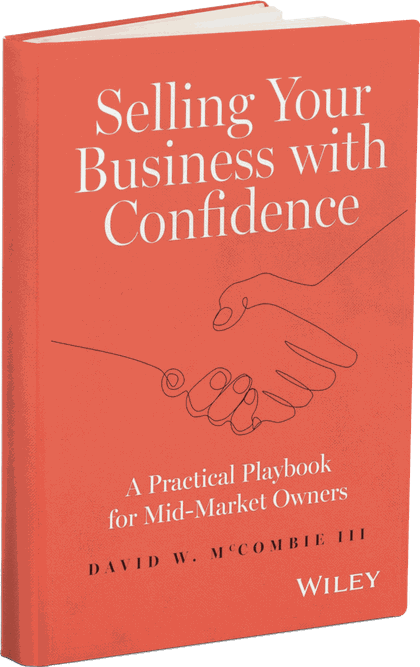
Author of Selling Your Business with Confidence (Wiley, 2024).
David also serves on the executive committee of the Miami chapter of YPO, the global community of chief executives.
A confidential conversation, or a realistic view of your range. Both are free, and both are useful even if you do nothing for years.
Free and confidential: about two minutes of questions, then a preliminary value range by email.
The information on this page describes capital-raising services and is provided for general informational purposes only. Nothing on this page is an offer to sell or a solicitation of an offer to buy any security, nor a recommendation regarding any security or investment. Any such offer or solicitation will be made only through definitive transaction documents to eligible investors, and only in compliance with applicable federal and state securities laws. Capital-raising or any other transactions involving the offer, purchase, or sale of securities are conducted through GT Securities, Inc., a broker-dealer registered with the SEC and a member of FINRA and SIPC. Past results are not indicative of future outcomes. No assurance can be given that any transaction will be completed or achieve any particular result.
Illustrations on this page are hypothetical and do not predict or promise any outcome. Not legal or tax advice.